
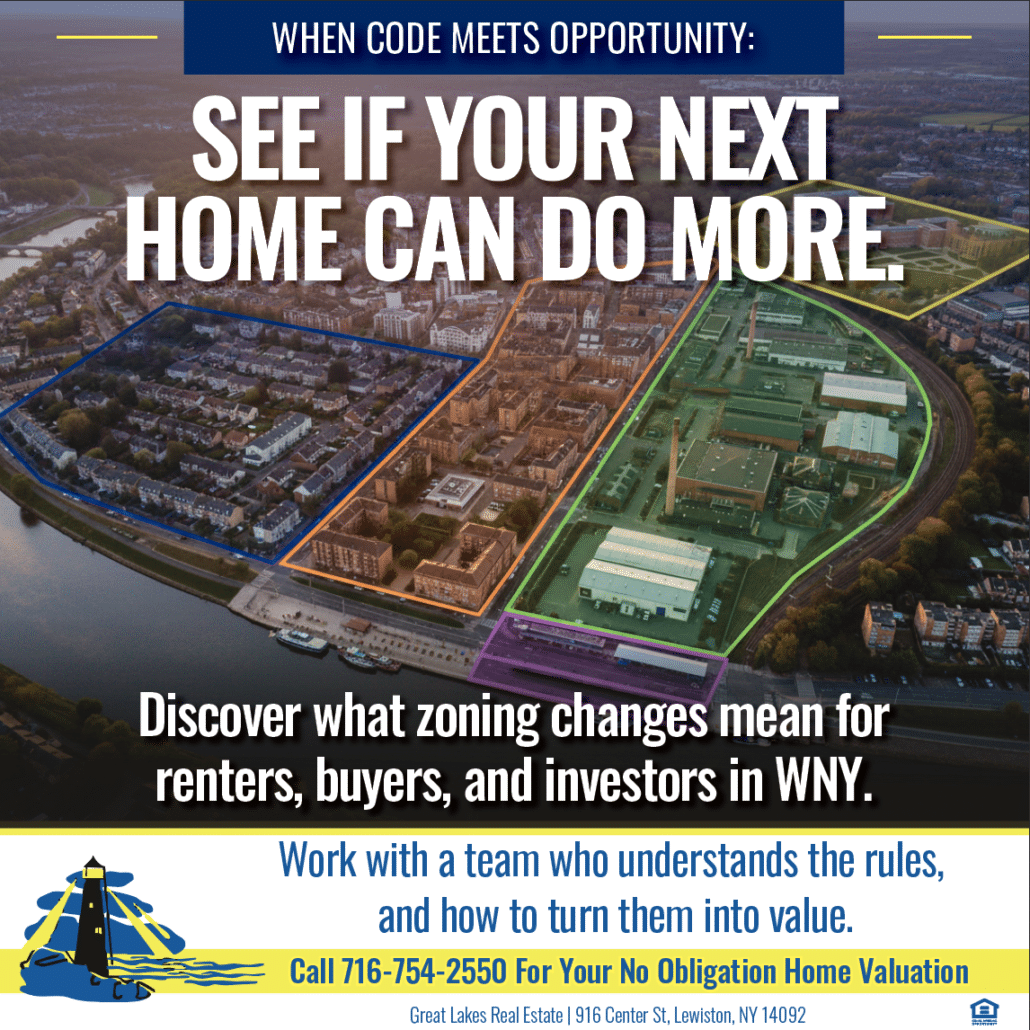
WNY’s Biggest Real Estate Shift Isn’t Rates — It’s Zoning. Here’s What It Means for You.

If you’ve been watching the housing market in Western New York, you may have missed one of the biggest shifts happening quietly: zoning laws are changing — and in many cases, for the better.
For buyers, investors, and homeowners, that means new opportunities: accessory dwelling units (ADUs), smaller lot splits, more flexible multi-unit zoning, and expanded choices. Understanding these changes could give you a strategic advantage when buying, investing, or renovating in 2026.
Here’s what’s new — and why it matters for you.
What’s Changing: More Flexibility, More Options
Accessory Dwelling Units (ADUs) Are Expanding
Many towns and municipalities in Erie County have recently amended zoning codes to allow ADUs — sometimes by right, sometimes with simple administrative approval. For example:
- In 2025, Erie County updated its regulations so that single-family detached dwellings (in all residential zoning districts) can now include one ADU — whether attached, internal, or detached.
- That means homeowners who want to add an in-law apartment, basement unit, or backyard cottage may now do so legally without the heavy restrictions of the past.
- Communities are embracing ADUs as a way to increase housing supply, offer affordable living options, and support multi-generational living.
Lot Splits & Multi-Unit Flexibility Are Improving
- Towns like Tonawanda have updated zoning to allow more mixed-residential and multi-family housing through new or amended zones, removing minimum unit-size limits when converting single-family homes to multi-unit.
- This means buyers may find more opportunities for duplexes, triplexes, or small multi-unit homes — often at prices comparable to single-family houses — making them attractive for investors or families looking for rental income or flexible living arrangement.
More Permits, Fewer Barriers
- The new zoning updates streamline the approval process: many ADUs now qualify under standard administrative permits rather than going through long public hearings or variance processes.
- This lowers the entry barrier for homeowners who want to renovate or expand — a major benefit for investors, families looking for extra rental income, or multi-generational households.
What This Means for Buyers & Investors
For First-Time Buyers or Growing Families
- You might get more home for your money. A property with an ADU or multi-unit potential can offer rental income, helping offset your mortgage costs.
- Multi-generational households (parents, in-laws, grown children) get flexibility: live in one unit, rent the other, or house extended family.
- Entry-level cost for multi-unit living may now be lower than expected because many former large-lot properties are being subdivided or converted under expanded zoning rules.
For Investors Seeking Rentals or Multi-Unit Properties
- New zoning means more properties are legally convertible to duplexes/triplexes, expanding the pool of viable rental homes.
- ADU conversions — basement apartments, in-law suites, stand-alone cottages — can create additional income streams without buying separate properties.
- With streamlined permitting, investors can act faster and avoid delays, improving time-to-rent and return on investment.
For Homeowners Considering Sweat-Equity or Expansion
- Looking to build an in-law suite, add a cottage, or build a small rental unit on your lot? ADUs might be a legal, viable option now — and a way to increase property value and income.
- Zoning flexibility helps adapt to changing family needs (aging parents, adult children, home office + rental income, etc.) without leaving the neighborhood you love.
Things to Watch Out For — Zoning Is Local, Not Uniform
Because zoning laws are controlled at the municipal level, what’s legal in one town may not be in another. Here’s what to check:
- Which residential zoning district is the property in (R-1, mixed residential, rural, etc.) — that determines if ADUs or multi-unit conversions are permitted.
- Whether permits or special uses are required (some ADUs require special permits, other times they’re allowed by right).
- Lot size, parking requirements, setbacks, and minimum lot dimension requirements — especially if subdividing or converting.
- Whether the municipality restricts short-term rentals or requires owner occupancy if building an ADU or multi-unit property.
Because rules vary, it’s essential to work with an agent who knows the local zoning — and branches of government — intimately.
How Great Lakes Real Estate Helps You Navigate Zoning Smartly
At Great Lakes Real Estate, we don’t just show homes — we help you see their full potential. Here’s how we guide clients in this evolving zoning landscape:
- Local zoning expertise: We track updates across Erie and Niagara Counties so you don’t have to guess what’s legal.
- Property suitability reviews: Before you buy, we’ll help you assess whether a parcel qualifies for ADU or multi-unit conversion under local code.
- Investor-forward advice: Want to rent or convert? We can estimate potential rental income, conversion costs, and resale value.
- Smooth permitting guidance: We help connect you with local planners, contractors, and inspectors — smoothing the path from purchase to permit to occupancy.
- Flexible buying strategies: Whether you want a single-family home with flexibility built-in, or a multi-unit income property, we design a plan around your goals.
Why 2026 Could Be a Watershed Year for WNY Real Estate — If You Know Where to Look
Now is a critical moment. With zoning laws evolving and municipalities recognizing the need for more housing flexibility, buyers and investors who move now may benefit from early-mover advantages:
- Access to new multi-unit or ADU-enabled properties before competition rises
- Potential rental demand increase thanks to housing shortage
- Ability to shape remodeling or conversion plans before resale becomes saturated
If you’ve been waiting for a sign — this could be it.
If you’re looking to buy in Erie or Niagara County, want to explore ADU or multi-unit potential, or need a perspective beyond “just another listing,” call Great Lakes Real Estate at (716) 754-2550. We’ll help you understand zoning laws, identify opportunities, and plan your next move with clarity and confidence.
