
The House Is Perfect. But What Will It Cost You to Live There?
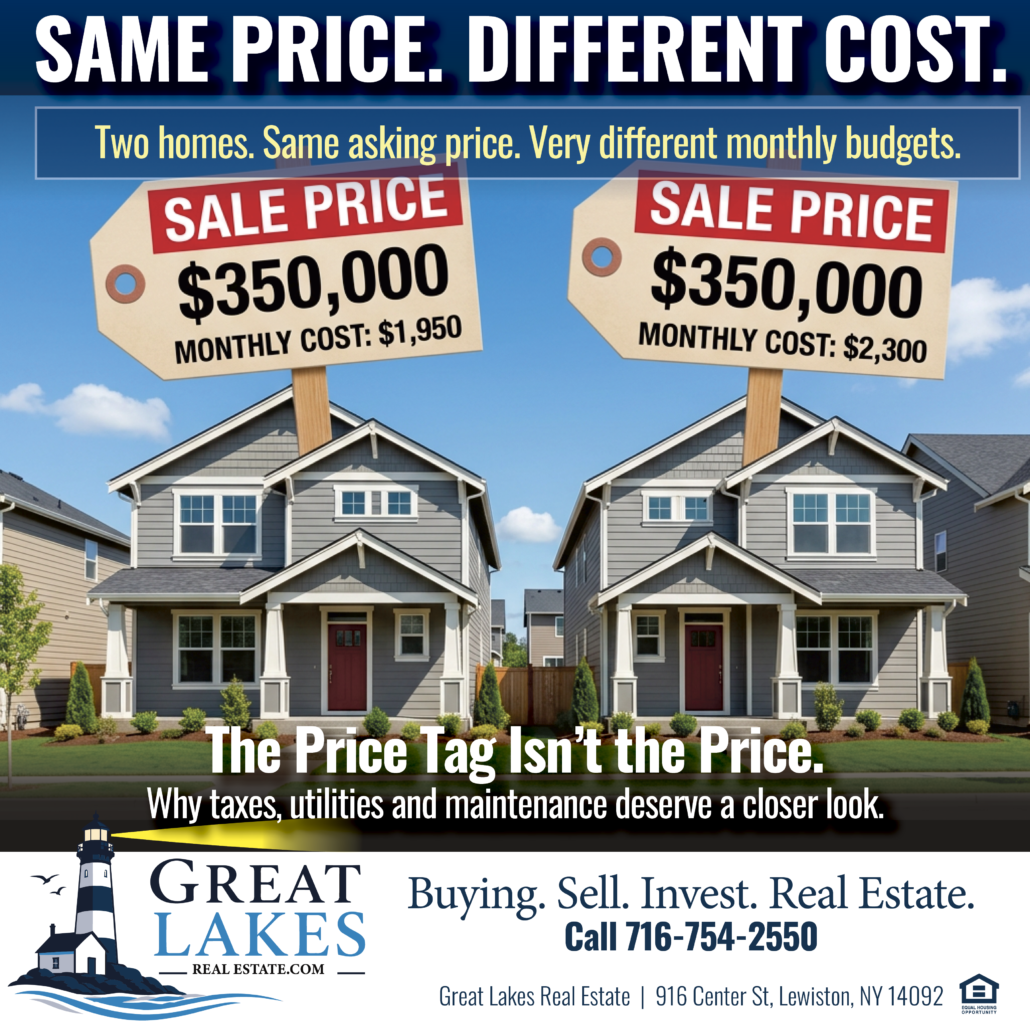
Two homes. Same asking price. Same mortgage. Yet one could cost hundreds more every month. Here’s why the price tag tells only part of the story.
Imagine spending a Saturday touring homes across Western New York. By the end of the afternoon, you’ve narrowed your search to two properties. Both are listed for $350,000, both offer approximately 2,000 square feet of living space, and both have the bedrooms, bathrooms and features your family needs.
The first is an older home in an established neighborhood with mature trees, plenty of character and a spacious backyard. The second is a newer property in a different community, with updated mechanical systems, modern insulation and a somewhat smaller lot. You like them both, and from a purchase-price perspective, they appear to be equally affordable.
Your mortgage lender has already confirmed that $350,000 fits your budget. Assuming the same down payment and financing terms, the principal-and-interest payment would be identical on either house.
So financially, they’re essentially the same choice.
Except they aren’t.
One property may carry significantly higher school and municipal taxes. The older house might require considerably more energy to heat through a Buffalo winter, while the newer property could have higher insurance costs or additional neighborhood fees. One may need a roof within five years, while the other has recently replaced its major mechanical systems.
By the time you account for those differences, the two homes could have monthly ownership costs hundreds of dollars apart.
For buyers throughout Erie and Niagara Counties, understanding that distinction can be just as important as negotiating the purchase price. The number on the listing tells you what it costs to buy the house. It doesn’t necessarily tell you what it costs to live there.
The Mortgage Payment Is Only the Starting Point
Most buyers begin their search with a price range. They meet with a lender, review their income and savings, and determine how much house they can reasonably afford. That process is important, but the maximum amount a lender is willing to finance isn’t necessarily the amount a household will feel comfortable spending every month.
Consider our two hypothetical $350,000 homes.
With a 20% down payment, each would require a $280,000 mortgage. At an illustrative fixed interest rate of 6.5% over 30 years, the principal-and-interest payment would be approximately $1,770 per month.
That’s where the similarities may end.
The buyer still needs to account for property taxes, homeowners insurance, utilities, maintenance and any applicable association fees. Some of these expenses are collected through the monthly mortgage payment, while others arrive as separate bills throughout the year.
A home that appears affordable based on principal and interest alone can become much less comfortable once those additional obligations are included.
This is especially relevant for first-time buyers who are accustomed to comparing monthly rent with an estimated mortgage payment. Rent generally represents a more predictable housing expense over the term of a lease, while ownership introduces costs that can fluctuate and occasionally arrive without much warning.
The goal shouldn’t simply be qualifying to purchase a home. It should be understanding whether the complete cost of ownership fits comfortably within the household budget.
Property Taxes Can Change the Entire Calculation
One of the most significant differences between similarly priced Western New York homes is property taxes.
Erie and Niagara Counties contain numerous towns, villages, cities and school districts, each with its own combination of tax levies, rates and assessment practices. Two properties with identical market values can have very different annual tax bills depending on their location, taxable assessed values and applicable exemptions.
Even neighboring communities can produce noticeably different results.
A buyer comparing homes in Amherst, Clarence, Hamburg, Tonawanda or Lockport may discover that the property tax obligations vary enough to affect the monthly budget. School district taxes can be a particularly important part of the calculation, and district boundaries don’t always align neatly with municipal boundaries.
For illustration, imagine one of our $350,000 homes carries an annual property tax bill of $5,000 while the other carries $8,000. That’s a $3,000 annual difference, or $250 every month, before considering any other expenses.
Both homes have the same asking price. Both have the same mortgage amount. But one already costs $250 more per month simply because of the tax obligation.
There’s another complication buyers should understand. The taxes shown on a real estate listing may reflect exemptions available to the current owner, including certain STAR benefits or other qualifying exemptions. Those benefits may not transfer to the buyer in the same form, and assessments or tax rates may change after the purchase.
A property’s current tax bill is an important starting point, but it shouldn’t automatically be treated as a guarantee of what the new owner will pay.
This is one reason local knowledge matters so much. Understanding the relationship between market value, assessed value, school districts and municipal taxes can help buyers avoid surprises after closing.
What Will It Cost to Heat the House in February?
Anyone who has lived through a Western New York winter understands that heating costs aren’t a minor detail.
A home’s age, insulation, windows, heating equipment, air sealing and overall efficiency can all influence how much energy it takes to keep the property comfortable.
Consider an older home with original windows, limited attic insulation and a furnace approaching the end of its useful life. It may have beautiful hardwood floors, generous room sizes and architectural details that are difficult to find in newer construction. But those features don’t tell a buyer much about what it costs to heat the house when temperatures fall below freezing.
A newer property with modern insulation, energy-efficient windows and updated mechanical systems may require less energy to maintain the same indoor temperature. Of course, newer doesn’t automatically mean more efficient, and a well-maintained older home with thoughtful improvements may perform exceptionally well.
The important point is that square footage alone doesn’t determine utility costs.
Two 2,000-square-foot homes can have substantially different heating bills based on their construction, equipment, exposure and the habits of the people living there.
Buyers should ask about available utility history, understand the type and age of the heating system, and pay attention to insulation, windows and other efficiency-related features during inspections.
Actual utility costs will vary with weather, energy prices and household usage, so the current owner’s bills aren’t a promise of what the next owner will spend. They can, however, provide useful context.
A difference of $100 per month in average utility expenses represents another $1,200 annually. Over ten years, that’s $12,000 before accounting for future changes in energy prices.
Suddenly, the charming older home and the newer property aren’t quite as similar financially as their asking prices suggest.
The Expenses You Can’t See During a Showing
Some of the most important ownership costs aren’t obvious when a buyer walks through the front door.
A home may be beautifully decorated, professionally photographed and meticulously maintained on the surface while still approaching several major repair expenses.
The roof may have only a few years of useful life remaining. The furnace could be twenty years old. The central air-conditioning system might still operate but require replacement in the foreseeable future. A driveway, sewer line or drainage system may need attention that isn’t immediately apparent during a typical showing.
These issues don’t necessarily make a home a poor purchase. Every property requires maintenance, and even newly constructed homes will eventually need repairs.
But there is a financial difference between purchasing a house with recently updated major systems and one where several expensive components may need replacement within the next five years.
Imagine buying a home that requires a $12,000 roof replacement two years after closing. Spread over the first 24 months of ownership, that single expense represents the equivalent of another $500 per month, although the homeowner would typically face the actual bill all at once.
That’s why maintenance shouldn’t be treated as an occasional surprise unrelated to the purchase decision. It’s part of the long-term cost of owning the property.
A professional home inspection can help identify visible concerns and provide information about the condition of major systems, although no inspection can predict every future repair. Buyers should use that information to plan, budget and decide whether a property’s condition is consistent with the price they’re paying.
A home that costs slightly more upfront but requires fewer immediate improvements may ultimately be the more manageable financial choice.
Insurance, Fees and the Costs Buyers Forget to Ask About
Homeowners insurance is another expense that can vary between properties with similar purchase prices.
Premiums may be influenced by replacement costs, the age and condition of the home, construction materials, location, coverage limits, deductibles and other underwriting factors. Two homes that sell for the same amount may cost different amounts to rebuild, which can affect insurance pricing.
Buyers should obtain property-specific insurance estimates before closing rather than relying on a generic figure.
There may also be additional expenses associated with a particular property. A condominium or planned community may have homeowners association fees that cover certain shared services or maintenance responsibilities. Those fees can make ownership more convenient, but they also become part of the monthly budget and may increase over time.
Some properties may require private septic system maintenance, well-water testing or other services that buyers unfamiliar with those arrangements haven’t previously considered. Others may have larger lots, extensive landscaping, long driveways or features that increase the cost of routine upkeep.
In Western New York, snow removal is another practical consideration. A long driveway or substantial sidewalk frontage may not seem particularly important during a July showing, but it can become a meaningful responsibility during January and February.
None of these factors should automatically discourage a purchase. They simply belong in the financial comparison alongside the mortgage payment.
Two $350,000 Homes. Two Very Different Budgets.
Let’s return to our original example and look at what the complete monthly picture might resemble.
Both properties are purchased for $350,000 with a 20% down payment and an illustrative 30-year fixed mortgage at 6.5%. The figures below are hypothetical and are intended to demonstrate how ownership costs can differ, not to represent actual tax bills or operating expenses for particular Western New York communities.
|
Monthly expense |
Home A |
Home B |
| Mortgage principal and interest | $1,770 | $1,770 |
| Property taxes | $667 | $417 |
| Homeowners insurance | $150 | $125 |
| Average utilities | $350 | $225 |
| Maintenance reserve | $300 | $175 |
| Estimated monthly total | $3,237 | $2,712 |
The difference is $525 per month.
Over one year, that’s $6,300. Over five years, it represents $31,500 in additional costs if those monthly differences remain unchanged.
The comparison doesn’t mean Home B is automatically the better purchase. Home A may offer a superior location, more land, a layout that better suits the family or features that justify the additional expense. Its maintenance needs could also turn out to be lower than anticipated, while Home B might encounter unexpected repairs.
And maintenance reserves aren’t necessarily bills paid every month. They represent money homeowners should consider setting aside for future expenses.
But the example illustrates why comparing purchase prices alone can be misleading.
The two homes cost exactly the same amount to buy. They don’t necessarily cost the same amount to own.
The Best Home Isn’t Always the One With the Lowest Price
There is an important distinction between finding an affordable house and finding a house you can comfortably afford to live in.
A property that stretches the monthly budget may leave little room for savings, travel, unexpected expenses or future improvements. Even when a buyer qualifies for the mortgage, that doesn’t guarantee the resulting lifestyle will feel financially comfortable.
On the other hand, a home with slightly higher upfront costs may offer advantages that reduce expenses over time. Updated mechanical systems, better energy efficiency, lower property taxes or fewer immediate maintenance needs can all contribute to a more predictable ownership experience.
Buyers should also consider how long they expect to remain in the property. Someone planning to move again in three years may evaluate major repair expenses differently from a family expecting to stay for twenty years.
The right decision involves more than identifying the lowest monthly payment. It requires balancing location, condition, convenience, long-term costs and the things that make a house feel like home.
That’s where a knowledgeable real estate agent can make a meaningful difference.
At Great Lakes Real Estate, our agents help buyers throughout Erie and Niagara Counties look beyond the listing price. Understanding neighborhood characteristics, property taxes, comparable sales and the condition of a home can provide valuable perspective before making one of life’s largest financial commitments.
A lender can help determine how much financing a buyer qualifies for. A home inspector can help evaluate the property’s condition. Insurance professionals and other specialists can provide estimates for expenses that deserve attention before closing.
Together, that information can help buyers make a decision based on the complete picture rather than the excitement of finding a home that looks perfect during a showing.
Because the real question isn’t simply whether you can afford to buy the house.
It’s whether you can comfortably afford to live there, maintain it and enjoy it for years to come.
Searching for a home in Western New York? Call Great Lakes Real Estate at (716) 754-2550 and let our experienced local agents help you compare properties, understand the costs beyond the asking price and find a home that truly fits your lifestyle and budget.

