
Before you forget about the hot upstairs, damp basement or backyard nobody used, think about what your home taught you this summer. Those little annoyances may be the best clues about where your next home improvement dollars should go. Our latest blog looks at why the best project for your home may be the one that solves a problem you already know you have. Read more →https://www.greatlakesrealestate.com/what-did-summer-teach-you-about-your-house/ #GreatLakesRealEstate #WesternNewYorkRealEstate #BuffaloRealEstate #HomeownerTips #HomeImprovement

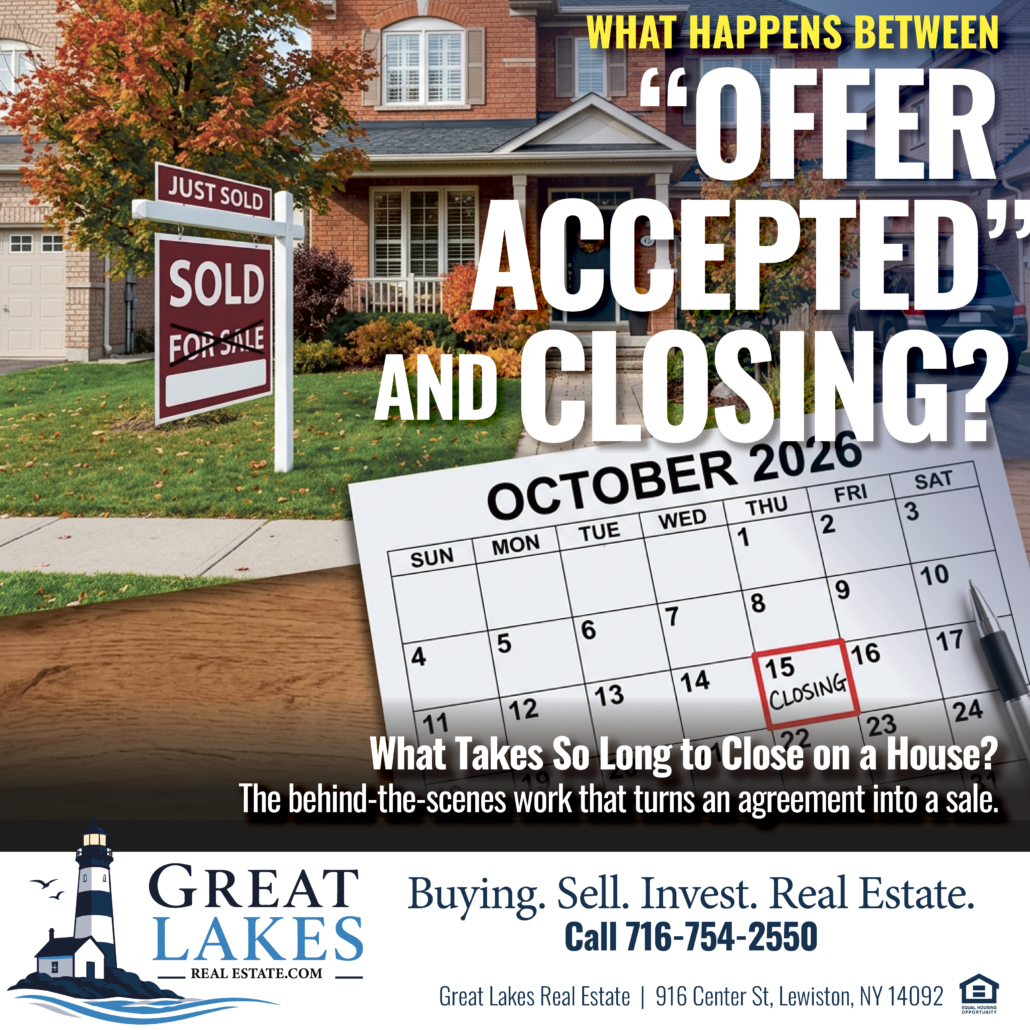
The sign may say “Pending,” but behind the scenes, some of the most important work in a real estate transaction is just beginning.
There is a moment in every home sale when it feels like the hard part is over.
The buyer made an offer. The seller accepted it. Everyone celebrates, the listing status changes, and attention naturally turns toward closing day.
Then comes the waiting.
For buyers and sellers who haven’t moved in a while, the stretch between an accepted offer and the closing table can feel surprisingly quiet. There may be days when nothing seems to be happening at all. In reality, this is often one of the busiest parts of the entire transaction.
Attorneys are reviewing documents. Inspectors may be evaluating the property. Lenders are verifying finances and working through underwriting. An appraisal may be ordered. Title work is being reviewed. Questions are being answered, conditions are being cleared and multiple professionals are working toward the same goal: getting the transaction safely from an agreement to a transfer of ownership.
In New York, there’s another important distinction worth understanding. An accepted offer and a fully executed contract aren’t necessarily the same thing. Agreements involving the sale of real property generally need to be in writing and signed to create an enforceable contract, and the attorneys involved play an important role in moving the transaction into that next stage.
That makes “offer accepted” less of a finish line and more of a handoff.
The House Gets a Closer Look
Depending on the terms of the transaction, one of the first major steps may be the home inspection.
A showing tells a buyer whether they like a house. An inspection helps them better understand the house they’re buying.
The roof, foundation, electrical system, plumbing, heating and cooling equipment, moisture concerns and other components suddenly receive far more attention than they did during a 30-minute showing.
That doesn’t mean an inspector is supposed to produce a perfect report. Houses aren’t perfect, particularly in Western New York, where much of our housing stock has been standing for generations.
The important question is whether something discovered during the inspection affects the transaction under the terms the buyer and seller agreed to.
This is also why buyers shouldn’t confuse a lender’s appraisal with a home inspection. They serve very different purposes. The New York Attorney General specifically recommends an independent home inspection and cautions buyers not to rely on the lender’s appraisal as a substitute.
Meanwhile, the Mortgage Is Moving Through Its Own Process
If the buyer is financing the purchase, another transaction is essentially happening alongside the home sale.
The lender isn’t simply deciding whether the buyer can afford the mortgage. It is also evaluating the property that will secure the loan.
Documents may need to be updated. Employment, income, assets or other financial information may be verified. The file moves through underwriting, and the lender may request additional information before issuing final approval.
This is one reason buyers often hear the same advice after an offer is accepted: don’t make major financial changes without speaking with your lender.
A new car loan, a large financed purchase, a new credit account or a change in employment can potentially affect a mortgage application at exactly the wrong time.
For the buyer, the best strategy during this part of the transaction can be surprisingly simple: keep your finances boring until after closing.
Then Someone Has to Decide What the Home Is Worth
For many financed purchases, the lender will also require an appraisal.
This can make buyers and sellers nervous because the appraiser isn’t there to confirm that the agreed-upon price “feels right.” The appraisal is part of the lender’s risk assessment and provides an opinion of value based on the property and relevant market information.
Most of the time, this is simply another step toward closing.
But if an appraisal creates a problem, the next steps depend on the contract, financing and circumstances of the particular transaction. That’s where the details agreed upon earlier can suddenly become very important.
It’s another reminder that the highest offer isn’t always automatically the strongest offer. Price matters, but financing, contingencies and the overall structure of an offer can matter too.
The Title Has a Story of Its Own
While buyers are thinking about inspections and mortgages, attorneys and title professionals may be looking backward.
Who legally owns the property? Are there mortgages or other liens that need to be addressed? Are there title issues that need to be resolved before ownership can transfer?
Sometimes something that hasn’t mattered in everyday life for years suddenly becomes important because the house is changing hands.
An old lien may need attention. A survey can reveal a question about a fence or property boundary. A document may need clarification. New York court records offer examples where title work and surveys uncovered issues that had to be resolved before a transaction could proceed.
Most of these issues don’t make for exciting real estate television.
They are, however, exactly the kind of behind-the-scenes work that helps get people to the closing table.
The Seller Isn’t Finished Yet Either
Once an offer is accepted, sellers sometimes feel as though they can finally stop worrying about the house.
Not quite.
The property still needs to be maintained. Any agreed-upon work needs to be handled according to the transaction. Packing and moving have to happen, and the home generally needs to remain in the condition required by the agreement.
This is also not the ideal time to decide that something attached to the house would look great in your new place.
Questions about fixtures, appliances or other items included in the sale should have been addressed as part of the agreement. If there’s uncertainty, ask before removing something.
The safest assumption after accepting an offer is that the transaction isn’t complete until it actually closes.
And Then Comes the Final Walk-Through
Shortly before closing, buyers typically have an opportunity to see the home again.
The final walk-through isn’t another home inspection and it isn’t a chance to renegotiate the purchase because you’ve changed your mind about the kitchen cabinets.
It’s an opportunity to confirm that the property is in the expected condition, that agreed-upon matters have been addressed as required, and that nothing significant has changed since the buyer agreed to purchase it. Final walk-throughs are a recognized part of the pre-closing process, and New York guidance also stresses that promises about unfinished repairs should be documented rather than left to a handshake.
For buyers, this can be the moment when the transaction suddenly feels real again.
The rooms are empty. The seller’s furniture is gone. The house you’ve been looking at online, inspecting, financing and thinking about for weeks is finally about to become yours.
A Lot Has to Go Right Before Someone Gets the Keys
From the outside, a real estate transaction can look remarkably simple.
Offer accepted. Sold sign. Closing.
The middle is where much of the work happens.
Agents, attorneys, lenders, inspectors, appraisers and title professionals may all have a role, and one unanswered question can affect several other pieces of the transaction. That’s why communication becomes so important after an offer is accepted.
A good real estate agent isn’t disappearing because the house is “sold.” This is when experience can become especially valuable—helping clients understand what’s happening, keeping track of what comes next, communicating with the other professionals involved and helping address the inevitable questions that arise along the way.
Because getting an offer accepted is exciting.
Getting all the way to the closing table is the goal.
Buying or selling a home in Western New York? Call Great Lakes Real Estate at (716) 754-2550 and let our local team guide you from the first showing through the closing table.
