
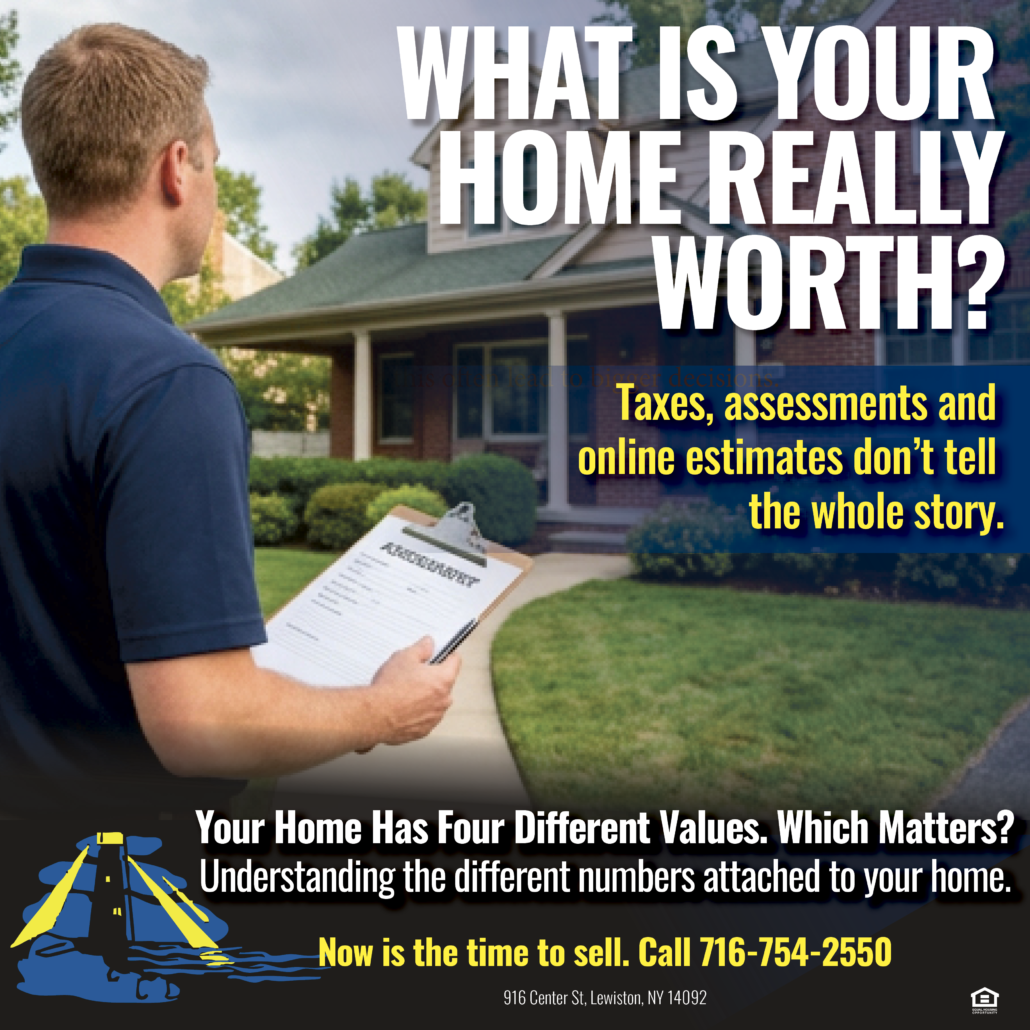
What Does Your Town Think Your Home Is Worth?

Why your assessment, market value, appraisal and online estimate can all tell a different story.
Ask four different people what your home is worth and you might get four very different answers.
Your town has a number. Zillow has a number. An appraiser may eventually have another. And if you put your home on the market tomorrow, buyers could decide it’s worth something different from all three.
For homeowners, that can be confusing. If your latest assessment says your home is worth $325,000 but an online estimate says $385,000, which one should you believe? And if your neighbor just sold for $410,000, does that mean your house is worth that much too?
The answer isn’t necessarily that one number is right and the others are wrong. They’re often attempting to answer different questions.
That’s always been important for homeowners to understand, but it deserves even more attention in today’s market. Mortgage rates have climbed from their spring lows this summer, and buyers aren’t simply looking at the price on the For Sale sign anymore. They’re calculating what that house will cost every month once the mortgage, property taxes and insurance are added together.
Here in Western New York, where property taxes can vary considerably from one municipality or school district to another, those numbers matter.
So let’s start with the one that arrives in your mailbox.
What Your Town Is Actually Trying to Determine
When your municipality assigns an assessed value to your property, it isn’t setting the price you should ask when you eventually decide to sell.
The assessment exists primarily to help determine your share of local property taxes.
That distinction gets lost surprisingly often because assessment notices use words like “value,” and homeowners naturally compare that number with what homes are selling for around them.
New York makes things a little more complicated because municipalities don’t necessarily assess property at the same percentage of market value. One municipality may assess at or near full market value while another may assess at a fraction of it. The state uses equalization rates to account for those differences when necessary.
That’s why comparing the raw assessment of a home in Amherst with one somewhere else in Western New York doesn’t necessarily tell you which property is considered more valuable.
And it’s why your assessed value shouldn’t automatically become your asking price.
Your Tax Bill Adds Another Layer
Property taxes can create even more confusion because homeowners sometimes assume an increase in assessment means their taxes will increase by exactly the same percentage.
It isn’t that simple.
Your tax bill is influenced not only by your assessment but also by tax levies, tax rates, exemptions and the various jurisdictions that collect property taxes, including municipalities, counties and school districts.
The assessment helps determine how the tax burden is distributed. It doesn’t operate in isolation.
For someone who plans to remain in their home for years, understanding that distinction is useful.
For someone preparing to sell, it becomes even more important because the next person looking at those taxes isn’t thinking about them only once a year.
They’re turning them into a monthly payment.
Today’s Buyers Are Doing the Math
Imagine two Western New York homes both listed for $350,000.
They may look comparable online. Similar square footage. Similar number of bedrooms. Similar condition.
But if the annual property taxes on one are significantly higher than the other, those houses don’t necessarily cost a buyer the same amount each month.
That difference becomes more noticeable when mortgage rates are already elevated.
Buyers who could comfortably afford a particular price range when borrowing costs were lower may now be watching every component of their monthly payment more closely. A few hundred dollars here or there can affect what they qualify for or how comfortable they feel making an offer.
That doesn’t mean a home with higher taxes can’t command a strong price. Buyers consider school districts, location, services, lot size, condition and countless other factors.
It simply means the asking price isn’t the only number they’re evaluating.
Then the Market Gets a Vote
This is where assessed value and selling price begin to separate.
When Great Lakes evaluates what a home could realistically sell for, we’re not simply pulling the assessed value from the tax record and adding a percentage.
We’re looking at what buyers have actually been willing to pay for comparable homes.
What recently sold nearby? How similar were those properties? What condition were they in? How quickly did they sell? What else is currently available? Is inventory tight in that particular price range? How desirable is the location?
Then there are things that are much harder to capture in a database.
Maybe you’ve completely renovated the kitchen. Maybe the backyard is exceptional. Perhaps your home sits on the better side of the street, has a layout buyers love or has been meticulously maintained for 25 years.
The town’s assessment doesn’t walk through your front door and experience those things.
A buyer does.
And ultimately, that’s where market value becomes real.
The Appraiser May See It Differently Again
Even after a buyer and seller agree on a price, another opinion may enter the transaction.
If the buyer is financing the purchase, the lender will commonly require an appraisal. The appraiser evaluates the property and comparable sales to develop an independent opinion of value that helps the lender determine whether the property adequately supports the loan.
Most of the time, this is simply another step toward closing.
Occasionally, however, the appraisal and the agreed-upon purchase price don’t match.
That’s when homeowners discover firsthand that an accepted offer and an appraised value aren’t necessarily the same thing.
A buyer can decide a home is worth $400,000 to them. An appraiser can reach a different conclusion based on the available evidence.
Neither number is your tax assessment.
And neither came from Zillow.
About That Zestimate…
Online estimates have added yet another number to the conversation.
They’re incredibly convenient. Type in an address and within seconds an algorithm provides an estimated value for the property.
There’s nothing wrong with looking.
The problem comes when an estimate generated from available data is treated as though it’s the same thing as putting a home on the open market.
An algorithm can analyze square footage, public records and nearby sales. What it can’t fully experience is the house itself.
It doesn’t stand in your newly renovated kitchen. It doesn’t notice how beautifully the backyard opens to the living space. It doesn’t feel the difference between a home that has been meticulously maintained and another with the same basic statistics that needs significant work.
Most importantly, it isn’t making an offer.
Online estimates can be useful reference points. They simply shouldn’t be confused with an actual buyer’s reaction to your home.
One House, Four Different Numbers
This is how one property can seemingly have several values at the same time without any of them necessarily being a mistake.
The municipality has an assessed value used as part of the property-tax system.
An online platform has an automated estimate based on its available data and methodology.
An appraiser can develop an independent opinion of value for a lender or another purpose.
And the real estate market determines what actual buyers are willing to pay for the home today.
Those numbers may be relatively close.
They may also be surprisingly far apart.
Understanding why is much more useful than simply choosing whichever number you like best.
Why This Conversation Matters More Right Now
Higher borrowing costs have changed the way buyers look at affordability.
A few years ago, when mortgage rates were exceptionally low, buyers had considerably more purchasing power for the same monthly principal-and-interest payment. Today’s elevated rates have made the complete cost of homeownership more important to the decision.
That puts property taxes squarely into the conversation.
For sellers, it means understanding both sides of the equation. You need to know what the current market says about your home’s value, but you also need to understand what owning your home will cost the buyer who’s considering it.
That’s particularly important in Western New York, where crossing a municipal or school-district boundary can change the financial picture even when two homes have similar asking prices.
How Great Lakes Real Estate Helps Make Sense of the Numbers
At Great Lakes Real Estate, we meet homeowners all the time who already have a number in mind before we walk through the door.
Sometimes it came from their assessment.
Sometimes it’s an online estimate.
Sometimes it’s what the neighbor’s house sold for.
And sometimes it’s simply the number they’ve always believed their home should be worth.
Those are all useful places to begin a conversation. They just aren’t where the conversation should end.
Determining a realistic selling price means looking at the home itself, recent comparable sales, current competition, buyer behavior and what’s happening right now in that particular Western New York market.
Because your home isn’t being sold to the town assessor.
It isn’t being sold to an algorithm.
It’s being sold to a buyer.
The Bottom Line
So, what is your home really worth?
Your town can give you one answer. An appraisal can give you another. The internet can produce an estimate before you finish your morning coffee.
But if you’re thinking about selling, there’s another number that matters most: what today’s market is willing to pay.
And with mortgage rates elevated and buyers paying closer attention to taxes and the total monthly cost of ownership, understanding how all of those numbers work together has become increasingly important.
Before you price your home based on an assessment, an old appraisal or an online estimate, find out what you’re actually competing against and what buyers are paying for homes like yours today.
At Great Lakes Real Estate, that’s where the real conversation about value begins.
Call (716) 754-2550. Let’s find out what your home is really worth.

