
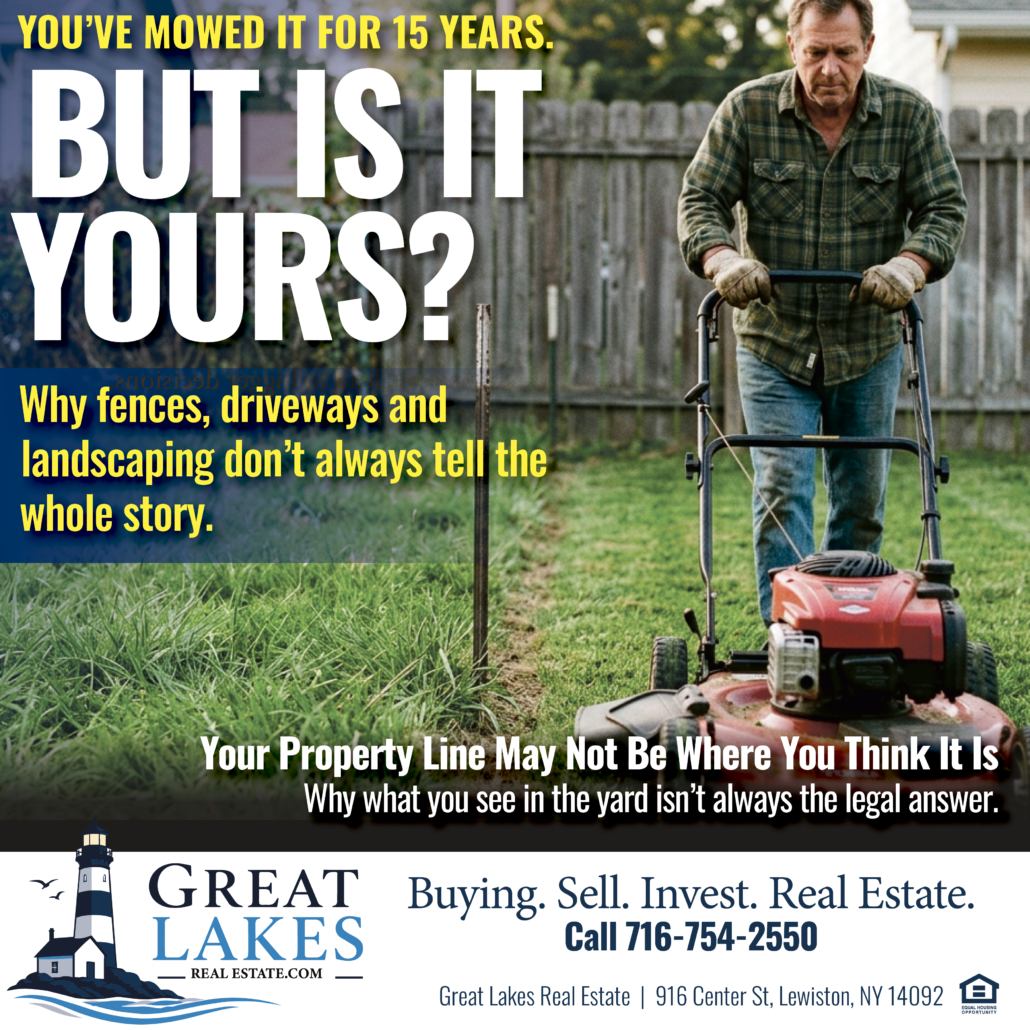
Your Property Line May Not Be Where You Think It Is
Why the fence, shed, driveway and lawn you’ve maintained for years don’t necessarily determine where your property ends.
You’ve mowed it for 15 years. Your fence surrounds it. The previous owner told you it was yours.
But is it?
Most homeowners have a pretty good idea where they believe their property begins and ends. Maybe there’s a fence separating the yards, a row of shrubs along one side or a driveway that has always seemed to create a natural boundary. After living in a home long enough, those lines become so familiar that there seems to be little reason to question them.
The problem is that a property line isn’t determined by where the grass changes color or where someone decided to put up a fence 30 years ago.
And sometimes homeowners don’t discover the difference until they’re ready to sell.
The Fence Is a Clue, Not Necessarily the Answer
It’s easy to assume a fence sits directly on the property line, but that isn’t always the case. A previous owner may have intentionally installed it several feet inside the boundary. Someone may have followed an old fence that was already in the wrong place, or neighboring homeowners years ago may simply have agreed that a particular location worked for them.
The same thing can happen with sheds, landscaping and driveways.
A driveway may curve slightly onto a neighboring parcel. A shed could sit closer to—or even across—a boundary than anyone realized. A row of bushes planted decades ago can begin to feel like the official dividing line between two properties even when the legal boundary is somewhere else.
That doesn’t automatically mean there’s a major problem. In fact, neighboring homeowners can live for decades without ever questioning an arrangement.
Real estate transactions have a way of making people start asking questions.
Selling Can Bring Old Assumptions Into the Spotlight
When a home is being prepared for sale, buyers may want to understand exactly what they’re purchasing. Attorneys, title professionals, lenders and surveyors can become involved in the transaction, and suddenly something everyone in the neighborhood has taken for granted deserves a closer look.
Imagine marketing a home with a beautiful fenced backyard only to discover that the fence doesn’t actually follow the property boundary. Or consider a buyer who believes a shed, parking area or portion of a driveway is entirely within the property they’re purchasing and later learns otherwise.
Boundary disputes can become more than theoretical. A New York court case decided this summer involved neighboring Brooklyn properties and a disputed three-foot strip of land. Surveys became important evidence in determining where the boundary actually ran while one of the properties was being marketed for sale.
That’s an extreme example, but it illustrates why something that seemed unimportant for years can become much more significant when ownership changes.
“But I’ve Taken Care of That Land for Years”
This is where another common misconception comes into play.
Some homeowners have heard that if they mow, maintain or use a neighbor’s property for enough years, it eventually becomes theirs through something called adverse possession.
New York law is considerably more complicated than that.
Adverse possession requires specific legal conditions, including occupancy that meets standards such as being adverse under a claim of right, open and notorious, continuous, exclusive and actual for the applicable statutory period. Even more importantly for the average suburban homeowner, New York law specifically says that mowing a neighbor’s lawn or performing similar maintenance across a boundary is considered permissive rather than adverse. The law also addresses certain minor non-structural encroachments such as fences, hedges, plantings and sheds.
In other words, mowing an extra three feet of grass for years does not, by itself, make it yours.
If there is a genuine ownership or boundary dispute, that’s a conversation for a qualified surveyor and real estate attorney rather than neighborhood folklore.
So How Do You Know Where Your Property Actually Ends?
This is where the paperwork becomes important.
You may already have a survey from when you purchased the property. Pulling out your closing documents and taking another look can be worthwhile, particularly if you haven’t seen them in years.
A professional land survey can identify property boundaries and show how physical improvements relate to them. Depending on the survey and circumstances, that can include structures, fences, driveways and other features that may be important when trying to understand exactly what’s happening along a boundary.
That information can become especially valuable before making a significant change to the property.
If you’re planning a new fence, shed, addition, pool or other improvement near a property line, assuming you know where the boundary sits can be an expensive gamble. Local setback and permit requirements can add another layer, so homeowners should check the rules in their particular municipality before beginning a project.
Finding out where the line actually is before you build is considerably easier than finding out afterward.
Shared Driveways Can Add Another Layer
Western New York’s housing stock can make these issues particularly interesting.
In older neighborhoods, homes may sit relatively close together. Driveways can run alongside property lines, garages may be near neighboring parcels and arrangements that have existed for generations can seem completely normal.
But the physical location of something and the legal right to use it aren’t always the same question.
A shared driveway, for example, may involve easement or access rights that remain relevant when the property changes hands. That doesn’t necessarily mean there’s anything wrong with the arrangement. It simply means buyers and sellers should understand what rights exist rather than relying on “we’ve always used it this way.”
That’s another reason the documents attached to a property matter just as much as what you can see during a showing.
Homeownership Is Full of Things We Assume
This is really what makes property boundaries such an interesting homeowner topic.
We live with physical cues.
That’s our fence. That’s their tree. This side of the driveway is ours. Dad always mowed up to that bush. The previous homeowner said the property went back to that big maple tree.
After enough years, those statements begin to feel like facts.
Usually, they may be perfectly accurate.
But when you’re buying, selling or making a significant improvement, “that’s how it’s always been” isn’t the same thing as knowing.
We’ve talked before about the paper trail attached to a home, and property boundaries are another good example of why that paperwork matters. A deed, survey, title documents, easements and municipal records can tell a story about your property that isn’t necessarily visible from the backyard.
Know Before It Matters
Nobody needs to spend this weekend pacing the backyard wondering whether the neighbor owns the hydrangeas.
For most homeowners, property lines will never become a major issue.
But if you’re thinking about selling, buying a home, installing a fence, building an addition or making another improvement near the edge of your property, it’s worth knowing where the line actually is before that information becomes urgent.
Find your old survey if you have one. Understand what it shows. If something doesn’t seem right or there’s a genuine question about a boundary, talk with the appropriate professionals before making assumptions or taking action.
A fence can move.
A lawn can look like it belongs to either house.
And a handshake between neighbors 25 years ago may not tell the next homeowner everything they need to know.
At Great Lakes Real Estate, part of helping Western New York homeowners buy and sell confidently is knowing which questions should be asked before they become problems. From Erie County to Niagara County, every property has more to its story than what you see in the listing photos.
Sometimes, that story begins with figuring out exactly where the property ends.
Call (716) 754-2550. We’re here whenever you’re ready for what’s next.

