
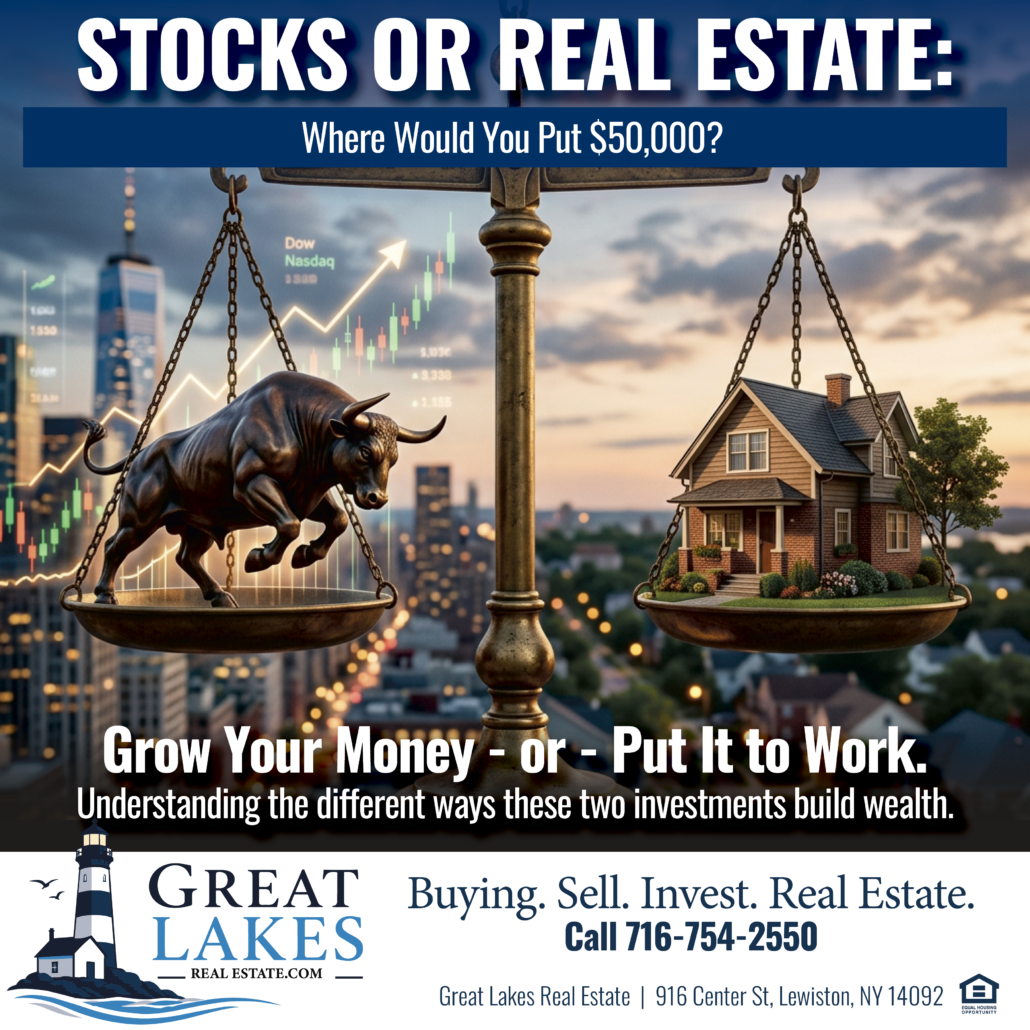
Stock Market or Real Estate: Where Should You Put Your Money?

Both have built wealth for generations. But they do it in very different ways—and understanding those differences may matter more than choosing a winner.
Imagine you have $50,000 available to invest. You could put it into a diversified stock portfolio, leave it there for the next decade and hope to benefit from the long-term growth of American businesses. Or you could use that same money toward the purchase of a property, giving you control of an asset worth considerably more than the cash you initially invested.
Which is the better investment?
It is one of those questions that sounds as though it should have a simple answer. Look at historical returns, compare the percentages and choose whichever number is higher. In reality, stocks and real estate create wealth in very different ways, carry very different risks and ask very different things of the person investing.
The stock market has an impressive long-term record and advantages that real estate simply cannot match. Property, however, offers something stocks don’t: a tangible asset that can potentially appreciate while producing income, being improved by its owner and being purchased partly with someone else’s money.
That combination helps explain why real estate has remained such a powerful wealth-building tool. The better question, then, may not be which investment wins. It may be which kind of risk—and which kind of opportunity—makes the most sense for you.
The Stock Market Makes a Strong Case
It would be difficult to have an honest conversation about investing without acknowledging what stocks do exceptionally well.
A diversified stock portfolio gives an investor access to hundreds of companies without having to manage those businesses personally. There are no tenants calling because the furnace stopped working, no property taxes to pay directly, no roof to replace and no closing costs when you decide to invest another $1,000.
Stocks are also remarkably liquid. If you need to sell part of an investment, that can generally happen quickly. Selling a house takes considerably more time and comes with transaction costs that make real estate poorly suited to money you may need next month.
Most importantly, stocks have historically been excellent long-term investments. Recent returns have been particularly strong; as of August 2026, the S&P 500 had produced a 10-year annualized price return of roughly 13.5%. That doesn’t mean investors should expect anything close to that every year, and past performance certainly doesn’t guarantee future results, but it demonstrates why equities deserve a place in a long-term financial strategy. S&P Global
The tradeoff is that the value of a stock portfolio is repriced constantly.
Markets react to earnings, interest rates, inflation, politics, wars, technology and investor expectations. A portfolio can gain or lose thousands of dollars while you’re eating lunch, even though nothing in your personal financial situation changed that day. Long-term investors learn to live with those fluctuations because selling during a downturn can turn a temporary decline into a permanent loss.
That volatility isn’t necessarily a reason to avoid stocks. It is simply part of what owning them requires.
Real Estate Builds Wealth Differently
Real estate isn’t usually as exciting on a Tuesday afternoon.
Your house doesn’t have a ticker running across the bottom of a television screen telling you its value every 15 seconds. There isn’t a closing bell announcing whether your duplex gained or lost 1.2% that day.
For many investors, that’s part of the appeal.
Property values certainly can decline, and anyone who says real estate always goes up is ignoring history. Real estate also carries substantial risks: vacancies, repairs, taxes, insurance, financing costs, bad tenants and the possibility of purchasing the wrong property at the wrong price. Unlike a diversified stock fund, one investment property can also concentrate a significant amount of money in one building and one local market.
But real estate has several characteristics that make it unusual as an investment.
The first is leverage.
Suppose an investor has $50,000. Putting $50,000 into stocks gives that investor approximately $50,000 of market exposure. In real estate, that money might become part of the down payment and acquisition costs on a property worth considerably more, depending on the financing and type of property involved.
If that property appreciates, the investor participates in the change in value of the entire property—not merely the amount originally contributed.
Leverage works both ways, however. It can magnify gains, but it can also magnify losses. A mortgage doesn’t disappear because a property’s value falls, and the monthly payment still arrives whether a rental unit is occupied or not.
That is why buying the right property at a sustainable price matters so much.
A Property Can Potentially Pay You While Someone Else Helps Pay for It
Investment real estate adds another dimension that a primary residence doesn’t have: rental income.
A properly selected rental property may generate monthly income that helps cover the mortgage, taxes, insurance, maintenance and other expenses. Over time, mortgage payments can also reduce the loan balance, gradually increasing the owner’s equity.
That means an investor can potentially benefit in several ways at once: rental income, appreciation, loan paydown and, depending on the property and the investor’s circumstances, certain tax benefits.
None of those are guaranteed.
A rental property that looks profitable on paper can quickly become less attractive after a major repair, several months of vacancy or higher-than-expected insurance and property taxes. Tax treatment can also be complicated and should be discussed with a qualified tax professional rather than assumed when purchasing a property.
Still, the combination is powerful. Few investments allow an individual to borrow money to purchase an income-producing asset, have customers help pay down the debt and potentially benefit if the underlying asset increases in value.
That is one reason real estate deserves to be considered differently from simply comparing annual appreciation against annual stock-market returns.
Real Estate Gives the Owner Something Stocks Rarely Do: Control
If you own shares of a large corporation and dislike the company’s strategy, there isn’t much you can personally do to improve next quarter’s results.
Real estate is different.
An investor can renovate a kitchen, improve a unit, add amenities, correct deferred maintenance, improve management or reposition a property to make it more attractive to future tenants or buyers. In some situations, those decisions can directly influence both income and value.
That doesn’t make real estate passive. Quite the opposite.
Owning property can require time, judgment and money. Even investors who hire property managers remain responsible for the financial performance of the asset. A roof still eventually needs replacing, a furnace doesn’t care whether the owner had other plans for that month’s cash, and tenants expect a property to be properly maintained.
But that responsibility comes with a degree of control that many investors find appealing.
You aren’t simply hoping the market values your investment differently five years from now. You may have opportunities to actively make the asset better.
Is Real Estate Really the “Safer” Investment?
This is where the comparison becomes more nuanced.
Calling real estate safer than stocks without qualification would be misleading. A diversified stock portfolio can spread risk across hundreds of businesses, while buying one rental property concentrates capital in a single physical asset. Stocks are easier to sell, require less ongoing capital and don’t carry the possibility of a flooded basement or a $15,000 roof replacement.
Real estate, however, can feel more stable because its value isn’t displayed every second. More importantly, a carefully purchased property can give a long-term investor multiple ways to build value rather than relying exclusively on appreciation.
There is also the underlying usefulness of the asset. People need places to live. A home is not merely a number on a statement; it has a practical purpose regardless of what someone estimates its market value to be on a particular day.
Recent national housing data offers a good reminder that property appreciation is never universal or guaranteed. Home prices increased year over year in roughly 80% of metropolitan areas during the second quarter of 2026, which also means they did not rise everywhere. National Association of REALTORS®
The safer real-estate investment isn’t simply “buy a house.”
It is buying the right property, at the right price, with financing you can comfortably support and a realistic understanding of the expenses involved.
Maybe the Best Answer Isn’t Stocks or Real Estate
For many people, the smartest long-term strategy isn’t choosing one side and declaring the other a mistake.
Stocks offer diversification, liquidity, simplicity and a long history of wealth creation. Real estate offers leverage, potential income, equity growth, control and an asset you can actually use and improve.
They can complement each other.
Someone building retirement savings through a diversified investment account doesn’t necessarily need to stop investing in stocks to purchase real estate. Likewise, someone who owns a rental property doesn’t need every available dollar tied up in additional properties.
Diversification matters precisely because we don’t know which asset class will perform best during the next five, ten or twenty years.
But for someone looking beyond traditional investments and wondering whether their next $50,000 should simply disappear into another account, real estate deserves a serious look.
Not because it is guaranteed to outperform the stock market. It isn’t.
Not because property values can never fall. They can.
Real estate is compelling because one carefully chosen property can potentially do several jobs at once. It can produce income, build equity as debt is repaid, appreciate over time and give its owner opportunities to actively improve its value. And unlike watching a portfolio rise and fall on a screen, investors can see exactly what they own.
The key word is carefully.
The difference between a great real-estate investment and an expensive problem often begins before the purchase—with understanding the neighborhood, realistic rent potential, property condition, taxes, likely expenses and what similar properties are actually worth.
That’s where local knowledge becomes particularly valuable. Western New York isn’t one real-estate market. An investment opportunity in Buffalo may behave very differently from one in Amherst, Niagara Falls, Tonawanda, Hamburg or Lockport. Even two properties a few blocks apart can produce very different results.
You don’t need to believe that real estate will always beat the stock market to believe that owning the right property can be one of the most powerful ways to build long-term wealth.
Sometimes the best investment isn’t the one with the most exciting return on a screen.
It’s the one you understand, can afford to hold and are willing to own long enough to let it work.
This article is for general educational purposes and is not financial, investment, tax or legal advice. Investment decisions should be made based on your individual circumstances and, when appropriate, with qualified financial and tax professionals.
Thinking about adding real estate to your investment strategy? Call Great Lakes Real Estate at (716) 754-2550 and let our local team help you find and evaluate investment opportunities throughout Western New York.

